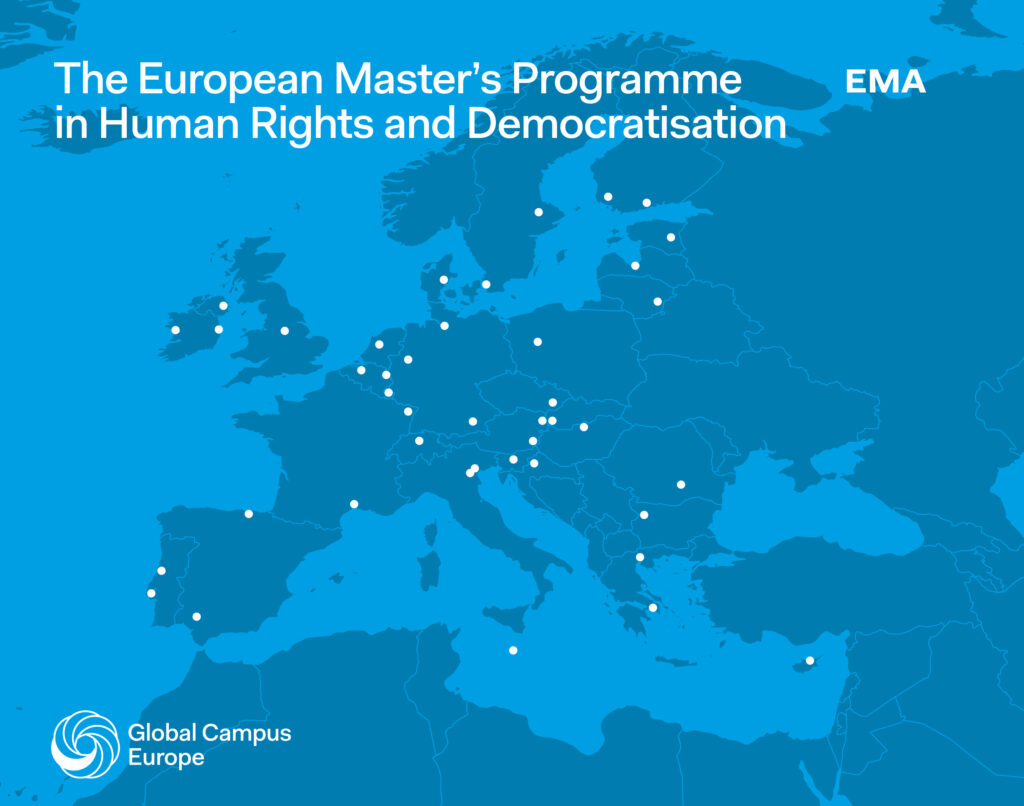
EMA is defined by inter-university cooperation among 43 prestigious universities
The EMA programme is co-designed, co-taught and governed by 43 participating universities and human rights centres representing all member states of the European Union as well as the United Kingdom and Switzerland. Each university is renowned for their leading role in education, research and advocacy in human rights and democratisation.
Each university is represented by an EMA National Director who sits on the EMA governing bodies. Together EMA National Directors work on curriculum development, teaching methodology, student selection and evaluation, and the awarding of degrees. This makes the EMA programme a unique example of inter-university cooperation in Europe. The benefits are multiple: for students, all the EMA participating universities together present a variety of perspectives that no single department or faculty could offer; for lecturers and experts, who devote their time and expertise to this common endeavour, the cooperation brings insight, inspiration, and a strong sense of community, which in turn enriches the participating institutions.
As a mark of our success in inter-university cooperation the EMA programme was accredited through the European Approach for Quality Assurance of Joint Programmes in 2025. This approach defines the European standard for joint degrees that are based on the agreed tools of the European Higher Education Area. Led by Ruhr University Bochum, this positive accreditation decision is strong evidence of the high quality of the EMA programme and its basis in inter-university cooperation which has been developed over the course of nearly 30 years of delivering postgraduate human rights education.
Fields of competence: International human rights law; international humanitarian law; United Nations, European and African human rights systems; globalization and human rights; human rights on the local level; human rights in South-Eastern Europe; human security; migration, asylum and human rights.
Fields of competence: International Investment Law, International Protection of Human Rights, Expropriation in International Law, Arbitration (Investment Arbitration, Business and Human Rights Arbitration), Implementation of International Human Rights Obligations in National Domestic Legal orders.
Fields of competence: Law, Sociology of Law, Human Rights Law, Rights of Minorities, Transitional Justice, Victimology, Medical Law, Women’s Rights, Social Policy, State of Emergency.
Fields of competence: Public international law, human rights, criminal justice, constitutional law, minority rights, asylum and migration, international organisations, development, law of the sea, autonomy.
Fields of competence: Minority Rights, Autonomy Regulations, Self-Determination of Peoples, Disarmament, UN Law, Air and Space Law, Law of Diplomatic Relations, Human Rights and Rule of Law, International Humanitarian Law.
Fields of competence: International Law and International Human Rights Law with particular expertise in a. the rights of indigenous peoples; b. social rights; c. regional human rights protection in the Americas; d. democratization and international standards on political participation.
Fields of competence: International Law including Use of Force and International Justice, Humanitarian Law, International and European Human Rights Law including Minorities, Migrants and Refugees, European Law and Institutions.
Fields of competence: International Law of human rights, International Human Rights Politics, Business and human rights, children’s rights women’s rights, human rights and inclusion.
Fields of competence: International, European and National Labour Law, Enterprises and Social Rights, Globalisation, Social Clauses, Codes of ethics, Free Trade Agreements, Corporate Social Responsibility, Sustainable Development, Human Rights and Labour Law, Industrial Relations, Global Value Chain, Labour Market, Labour Policies, Social Security Law.
Fields of competence: Human rights law, with specific expertise in socio-economic rights, international and European Union disability law, equality and non-discrimination law, inclusive education, the European Court of Human Rights, and technology and human rights.
Adam Mickiewicz University, Poznan / Poznan Human Rights Centre
Fields of competence: Human rights (in particular: the international system of the human rights protection and procedural issues) constitutional law – numerous publications, expert opinions and research projects in these areas.
Fields of competence: Constitutional Law, Human Rights Law, EU Law, International Law, Tax Law, Freedom of Religion, Freedom of Expression, Media Regulation.
Fields of competence: Criminal Law, Prisoners’ Rights, International Human Rights Law, Women’s Human Rights, Race and Ethnicity and Human Rights, Equality Law, Gender and Race Relations and Human Rights.
Fields of competence: International Relations (particular focus: ethno-national diversity management and minority protection/minority rights, conflict management, post-conflict reconstruction, socialisation/Europeanisation, norm diffusion, int’l regimes, Central and Eastern Europe and Western Balkans).
Fields of competence: Public International Law; International Human Rights Law and Procedures; International Pace and Security; International Humanitarian Law; International Criminal Law; Business and Human Rights.
Fields of competence: Human rights law, with particular expertise in (a) health and medical law, the life sciences and associated technologies, (b) migration, and (c) law and religion.
SWITZERLAND
EMA NATIONAL DIRECTOR TBC
Institute of Social Ethics – University of Lucerne